

Skip To Section
Why Google Sometimes Shows the “Wrong” Business — Even When You’re in the Same Postcode
If you’ve ever searched for a local business and Google showed you a company in another state, you’re not imagining things — and it’s not a glitch.
This case study explains why Google does this, using a real-world example involving two similarly named businesses:
- Coastal Shine Exterior Cleaning (Queensland)
- Coastal Shine Exterior Cleaning Co. (New South Wales)
The goal here isn’t to judge either business.
It’s to understand how Google actually decides which business panel to show — and why proximity alone doesn’t always win.
The Situation
- The search is performed within the service area of the Queensland business
- The business name searched is essentially identical
- Google displays the business panel for the NSW business instead
From a human perspective, that feels wrong.
From Google’s perspective, it’s a confidence decision, not a distance one.
A Crucial Distinction: Ranking vs Entity Identification
Google is answering two different questions, depending on the search:
1. “Which pages should rank for this query?”
This is organic SEO — blog posts, service pages, guides.
2. “Which business entity does this name refer to?”
This is entity recognition, powered by Google Business Profile.
The business panel on the right-hand side exists to answer question #2 — not to find the nearest option.
That distinction explains almost everything.
Why Proximity Didn’t Win Here
When you type a business name like:
“Coastal Shine Exterior Cleaning”
Google treats it as a brand lookup, not a “near me” search.
Before it even looks at location, it asks:
“Which business does this name most likely refer to?”
If Google isn’t fully confident, it defaults to the entity with the strongest historical signals.
The Core Factors Google Is Weighing
1. Entity Confidence (The Biggest Factor)
Google builds confidence over time using signals such as:
- How long the business name has existed in its system
- How often users search that name
- Which listing users usually click
- How consistently the business appears across the web
A longer-established entity often becomes the default interpretation of a name — even across state borders.
2. Review History (Not Just Ratings)
It’s not about who has the better star rating.
Google looks at:
- Total review count
- Consistency over time
- Review recency
- Language patterns in reviews
A business with steady reviews over years tends to feel “safer” to Google than a newer profile, even if the newer one is physically closer to the searcher.
3. Name Ambiguity (The Silent Problem)
Two businesses with:
- Near-identical names
- The same service
- The same country
…create what’s known as an entity collision.
When that happens, Google prefers certainty over precision.
4. Service-Area Business Limitations
Service-area businesses (no visible shopfront address) have:
- Softer geographic anchors
- Weaker proximity signals
This makes entity strength even more important.
The Key Takeaway So Far
Google does not reward proximity until it is confident about identity.
In brand-name searches, confidence beats closeness.
Signal-Only Comparison (Neutral & Factual)
Below is a non-judgmental comparison of the signals Google is likely evaluating.
This is about visibility mechanics, not business quality.
| Signal Type | Coastal Shine Exterior Cleaning (QLD) | Coastal Shine Exterior Cleaning Co. (NSW) |
|---|---|---|
| Business name uniqueness | Near-identical | Near-identical |
| Time in Google’s system | Newer entity | Longer-established |
| Review volume | Growing | Larger historical base |
| Review consistency | Building momentum | Long-term consistency |
| User search history | Still forming | Well-established |
| Service model | Service-area business | Likely stronger fixed signals |
| Geographic relevance (this search) | Very high | Low |
| Entity confidence (Google’s view) | Still consolidating | High |
Important:
This table reflects how Google interprets signals, not which business is “better”.
Why This Matters for Other Local Businesses
This situation affects:
- Trades and service businesses
- Businesses with generic or descriptive names
- Franchises and multi-state operators
- Newer businesses competing with older names
Most business owners don’t realise this dynamic exists — until it impacts visibility.
Unpacking What’s Going On
When searching Coastal Shine Exterior Cleaning, even though I’m searching locally, a business from New South Wales shows in the Business Panel instead:
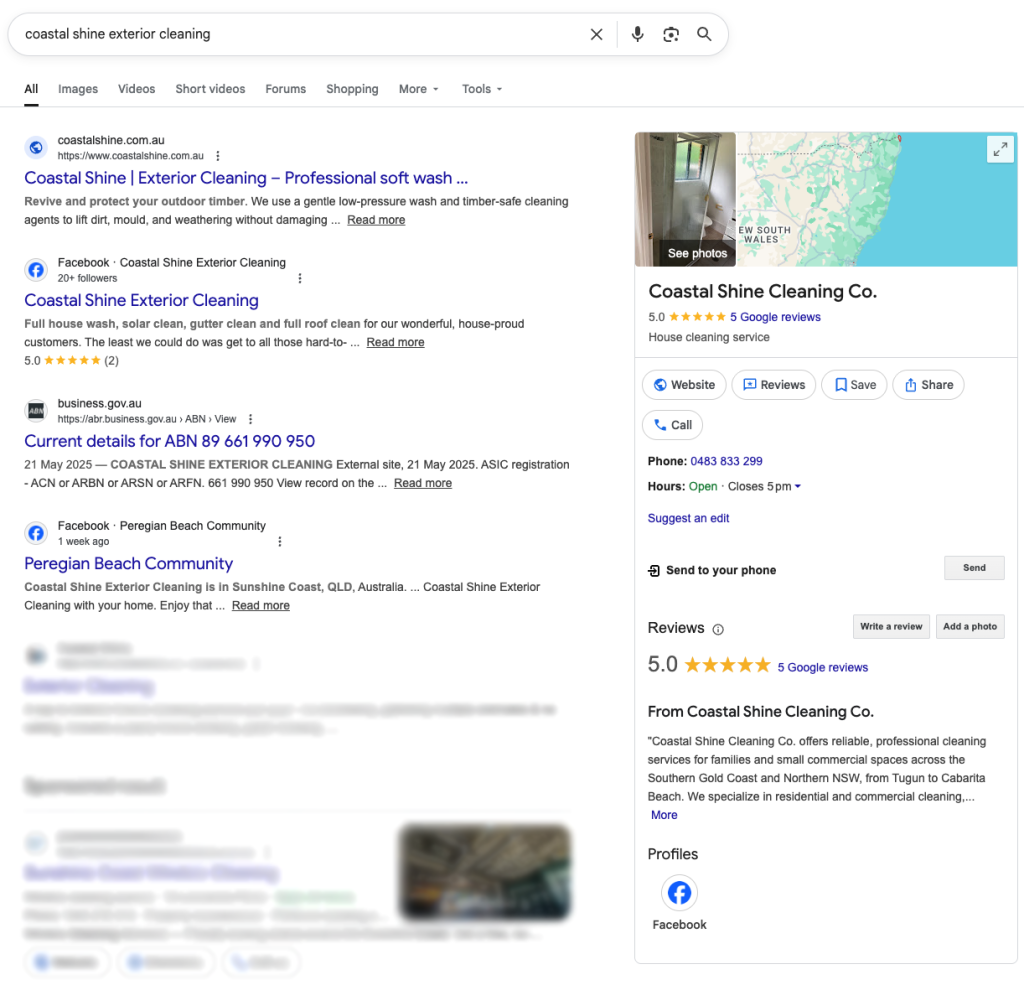
What we’re seeing
This panel appears when Google believes it knows exactly which business you’re looking for.
It is not showing:
- Nearby options
- Alternatives
- “Best” businesses
It is answering one question only:
“Which business does this name most likely refer to?”
Important:
This panel is powered by Google Business Profile, not your website.
Why the NSW Business Appears Here
Even though we’re physically near Coastal Shine Exterior Cleaning, Google is prioritising:
- Historical recognition of the name
- Prior user behaviour
- Review history
- Entity certainty
At this stage, distance is irrelevant.
The Business Name (This Is the Trigger)
Look closely at the name shown.
This is where the decision happens.
Google sees:
- “Coastal Shine”
- “Exterior Cleaning”
- No strong geographic modifier
It then asks:
“Which Coastal Shine Exterior Cleaning do people usually mean?”
If another business — such as Coastal Shine Exterior Cleaning Co. — has stronger historical signals, Google defaults to it.
This is called entity disambiguation.
Why Proximity Didn’t Help
Proximity only comes into play after Google is confident it has the right entity.
In brand-name searches:
- Identity first
- Confidence second
- Location later (if at all)
Reviews & Longevity Signals
What Google infers from reviews
Google doesn’t just see star ratings.
It sees:
- How long have reviews been accumulating
- Whether reviews arrive consistently
- How often users interact with the listing
- Language patterns that reinforce the business’s legitimacy
A business with long-term review history often feels safer to Google than a newer one — even if the newer one is closer.
This Is Not An “Unfair Advantage”
Google isn’t rewarding size or punishing new businesses.
It’s doing what risk-averse systems do:
“Show the option I’m least likely to get wrong.”
Why This Is NOT a “Near Me” Result
If the search were:
- “exterior cleaning near me”
- “pressure cleaning Sunshine Coast”
You’d likely see:
- Map results
- Local pack rankings
- Proximity heavily weighted
But this search is interpreted as:
“I’m looking for this business.”
That’s why the experience feels counter-intuitive.
Summary
Here’s the decision tree Google is using:
- Is this a brand-name search?
→ Yes - Do multiple businesses match this name?
→ Yes - Which entity am I more confident about?
→ The one with more history & signals - Show that business panel
→ Even if it’s interstate
Only after confidence is resolved does geography matter.
Why This Matters for Service Businesses
This affects:
- Trades
- Mobile services
- Businesses without shopfronts
- Businesses with descriptive names
Service-area businesses rely more on entity clarity than proximity.
That’s the quiet reality most guides don’t mention.
Google doesn’t show the closest business in the panel.
It shows the clearest one.
The Bigger Lesson
If your business name collides with another established entity, Google’s priority becomes:
“Which one am I more sure about?”
SEO tweaks alone won’t fix that.
What fixes it is building unmistakable entity clarity over time.
If you’d like help setting your Google Business Profile up properly (and making sure it matches what Google thinks you do), I can help via Local SEO.